 Add to Chrome
 Add to Firefox
 Add to Edge
TCDA: Thread-Constrained Discourse-Aware Modeling for Conversational Sentiment Quadruple Analysis
May 03, 2026
Conversational Aspect-based Sentiment Quadruple Analysis (DiaASQ) needs to capture the complex interrelationships in multiple rounds of dialogues. Existing methods usually employ simple Graph Convolutional Networks (GCN), which introduce structural noise and fail to consider the temporal sequence of the dialogues, or use standard RoPE, which implicitly captures relative distances in a flat sequence but cannot clearly separate the token-level syntactic order from the utterance-level progression, and may suffer from the Distance Dilution problem. To address these issues, we propose a new framework that combines Thread-Constrained Directed Acyclic Graph (TC-DAG) and Discourse-Aware Rotary Position Embedding (D-RoPE). Specifically, TC-DAG filters out cross-thread noise based on thread constraints, maintains global connectivity through root anchoring, and incorporates the temporal sequence of the dialogues. D-RoPE aligns multi-layer semantics using dual-stream projection and multi-scale frequency signals, captures thread dependencies using tree-like distances, and alleviates the token-level Distance Dilution problem by incorporating utterance-level progressions. Experimental results on two benchmark datasets demonstrate that our framework achieves state-of-the-art performance.

Re$^2$MoGen: Open-Vocabulary Motion Generation via LLM Reasoning and Physics-Aware Refinement
Apr 20, 2026Text-to-motion (T2M) generation aims to control the behavior of a target character via textual descriptions. Leveraging text-motion paired datasets, existing T2M models have achieved impressive performance in generating high-quality motions within the distribution of their training data. However, their performance deteriorates notably when the motion descriptions differ significantly from the training texts. To address this issue, we propose Re$^2$MoGen, a Reasoning and Refinement open-vocabulary Motion Generation framework that leverages enhanced Large Language Model (LLM) reasoning to generate an initial motion planning and then refine its physical plausibility via reinforcement learning (RL) post-training. Specifically, Re$^2$MoGen consists of three stages: We first employ Monte Carlo tree search to enhance the LLM's reasoning ability in generating reasonable keyframes of the motion based on text prompts, specifying only the root and several key joints' positions to ease the reasoning process. Then, we apply a human pose model as a prior to optimize the full-body poses based on the planned keyframes and use the resulting incomplete motion to supervise fine-tuning a pre-trained motion generator via a dynamic temporal matching objective, enabling spatiotemporal completion. Finally, we use post-training with physics-aware reward to refine motion quality to eliminate physical implausibility in LLM-planned motions. Extensive experiments demonstrate that our framework can generate semantically consistent and physically plausible motions and achieve state-of-the-art performance in open-vocabulary motion generation.
MAGE: Multi-scale Autoregressive Generation for Offline Reinforcement Learning
Feb 27, 2026Generative models have gained significant traction in offline reinforcement learning (RL) due to their ability to model complex trajectory distributions. However, existing generation-based approaches still struggle with long-horizon tasks characterized by sparse rewards. Some hierarchical generation methods have been developed to mitigate this issue by decomposing the original problem into shorter-horizon subproblems using one policy and generating detailed actions with another. While effective, these methods often overlook the multi-scale temporal structure inherent in trajectories, resulting in suboptimal performance. To overcome these limitations, we propose MAGE, a Multi-scale Autoregressive GEneration-based offline RL method. MAGE incorporates a condition-guided multi-scale autoencoder to learn hierarchical trajectory representations, along with a multi-scale transformer that autoregressively generates trajectory representations from coarse to fine temporal scales. MAGE effectively captures temporal dependencies of trajectories at multiple resolutions. Additionally, a condition-guided decoder is employed to exert precise control over short-term behaviors. Extensive experiments on five offline RL benchmarks against fifteen baseline algorithms show that MAGE successfully integrates multi-scale trajectory modeling with conditional guidance, generating coherent and controllable trajectories in long-horizon sparse-reward settings.
A Consistency-Improved LiDAR-Inertial Bundle Adjustment
Feb 06, 2026Simultaneous Localization and Mapping (SLAM) using 3D LiDAR has emerged as a cornerstone for autonomous navigation in robotics. While feature-based SLAM systems have achieved impressive results by leveraging edge and planar structures, they often suffer from the inconsistent estimator associated with feature parameterization and estimated covariance. In this work, we present a consistency-improved LiDAR-inertial bundle adjustment (BA) with tailored parameterization and estimator. First, we propose a stereographic-projection representation parameterizing the planar and edge features, and conduct a comprehensive observability analysis to support its integrability with consistent estimator. Second, we implement a LiDAR-inertial BA with Maximum a Posteriori (MAP) formulation and First-Estimate Jacobians (FEJ) to preserve the accurate estimated covariance and observability properties of the system. Last, we apply our proposed BA method to a LiDAR-inertial odometry.
GAS: Enhancing Reward-Cost Balance of Generative Model-assisted Offline Safe RL
Feb 05, 2026Offline Safe Reinforcement Learning (OSRL) aims to learn a policy to achieve high performance in sequential decision-making while satisfying constraints, using only pre-collected datasets. Recent works, inspired by the strong capabilities of Generative Models (GMs), reformulate decision-making in OSRL as a conditional generative process, where GMs generate desirable actions conditioned on predefined reward and cost values. However, GM-assisted methods face two major challenges in OSRL: (1) lacking the ability to "stitch" optimal transitions from suboptimal trajectories within the dataset, and (2) struggling to balance reward targets with cost targets, particularly when they are conflict. To address these issues, we propose Goal-Assisted Stitching (GAS), a novel algorithm designed to enhance stitching capabilities while effectively balancing reward maximization and constraint satisfaction. To enhance the stitching ability, GAS first augments and relabels the dataset at the transition level, enabling the construction of high-quality trajectories from suboptimal ones. GAS also introduces novel goal functions, which estimate the optimal achievable reward and cost goals from the dataset. These goal functions, trained using expectile regression on the relabeled and augmented dataset, allow GAS to accommodate a broader range of reward-cost return pairs and achieve a better tradeoff between reward maximization and constraint satisfaction compared to human-specified values. The estimated goals then guide policy training, ensuring robust performance under constrained settings. Furthermore, to improve training stability and efficiency, we reshape the dataset to achieve a more uniform reward-cost return distribution. Empirical results validate the effectiveness of GAS, demonstrating superior performance in balancing reward maximization and constraint satisfaction compared to existing methods.
Puzzle it Out: Local-to-Global World Model for Offline Multi-Agent Reinforcement Learning
Jan 12, 2026Offline multi-agent reinforcement learning (MARL) aims to solve cooperative decision-making problems in multi-agent systems using pre-collected datasets. Existing offline MARL methods primarily constrain training within the dataset distribution, resulting in overly conservative policies that struggle to generalize beyond the support of the data. While model-based approaches offer a promising solution by expanding the original dataset with synthetic data generated from a learned world model, the high dimensionality, non-stationarity, and complexity of multi-agent systems make it challenging to accurately estimate the transitions and reward functions in offline MARL. Given the difficulty of directly modeling joint dynamics, we propose a local-to-global (LOGO) world model, a novel framework that leverages local predictions-which are easier to estimate-to infer global state dynamics, thus improving prediction accuracy while implicitly capturing agent-wise dependencies. Using the trained world model, we generate synthetic data to augment the original dataset, expanding the effective state-action space. To ensure reliable policy learning, we further introduce an uncertainty-aware sampling mechanism that adaptively weights synthetic data by prediction uncertainty, reducing approximation error propagation to policies. In contrast to conventional ensemble-based methods, our approach requires only an additional encoder for uncertainty estimation, significantly reducing computational overhead while maintaining accuracy. Extensive experiments across 8 scenarios against 8 baselines demonstrate that our method surpasses state-of-the-art baselines on standard offline MARL benchmarks, establishing a new model-based baseline for generalizable offline multi-agent learning.
A Unified Framework for Emotion Recognition and Sentiment Analysis via Expert-Guided Multimodal Fusion with Large Language Models
Jan 12, 2026Multimodal emotion understanding requires effective integration of text, audio, and visual modalities for both discrete emotion recognition and continuous sentiment analysis. We present EGMF, a unified framework combining expert-guided multimodal fusion with large language models. Our approach features three specialized expert networks--a fine-grained local expert for subtle emotional nuances, a semantic correlation expert for cross-modal relationships, and a global context expert for long-range dependencies--adaptively integrated through hierarchical dynamic gating for context-aware feature selection. Enhanced multimodal representations are integrated with LLMs via pseudo token injection and prompt-based conditioning, enabling a single generative framework to handle both classification and regression through natural language generation. We employ LoRA fine-tuning for computational efficiency. Experiments on bilingual benchmarks (MELD, CHERMA, MOSEI, SIMS-V2) demonstrate consistent improvements over state-of-the-art methods, with superior cross-lingual robustness revealing universal patterns in multimodal emotional expressions across English and Chinese. We will release the source code publicly.
Do LLMs Feel? Teaching Emotion Recognition with Prompts, Retrieval, and Curriculum Learning
Nov 12, 2025Emotion Recognition in Conversation (ERC) is a crucial task for understanding human emotions and enabling natural human-computer interaction. Although Large Language Models (LLMs) have recently shown great potential in this field, their ability to capture the intrinsic connections between explicit and implicit emotions remains limited. We propose a novel ERC training framework, PRC-Emo, which integrates Prompt engineering, demonstration Retrieval, and Curriculum learning, with the goal of exploring whether LLMs can effectively perceive emotions in conversational contexts. Specifically, we design emotion-sensitive prompt templates based on both explicit and implicit emotional cues to better guide the model in understanding the speaker's psychological states. We construct the first dedicated demonstration retrieval repository for ERC, which includes training samples from widely used datasets, as well as high-quality dialogue examples generated by LLMs and manually verified. Moreover, we introduce a curriculum learning strategy into the LoRA fine-tuning process, incorporating weighted emotional shifts between same-speaker and different-speaker utterances to assign difficulty levels to dialogue samples, which are then organized in an easy-to-hard training sequence. Experimental results on two benchmark datasets -- IEMOCAP and MELD -- show that our method achieves new state-of-the-art (SOTA) performance, demonstrating the effectiveness and generalizability of our approach in improving LLM-based emotional understanding.
Learn as Individuals, Evolve as a Team: Multi-agent LLMs Adaptation in Embodied Environments
Jun 08, 2025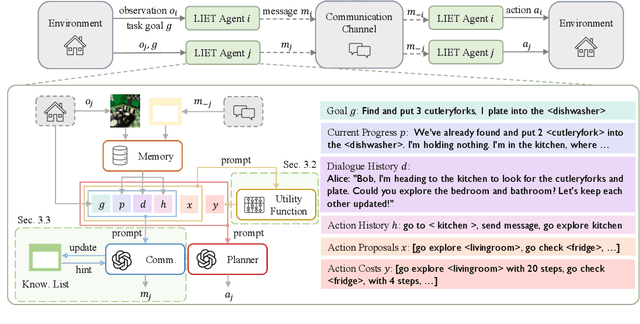
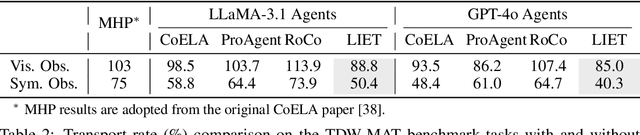
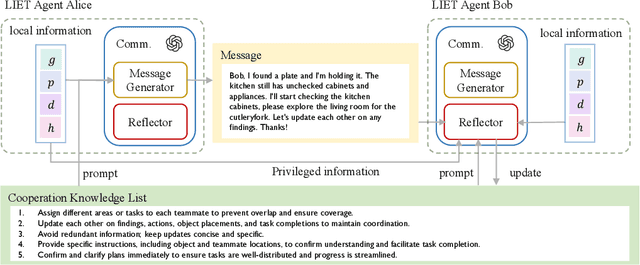
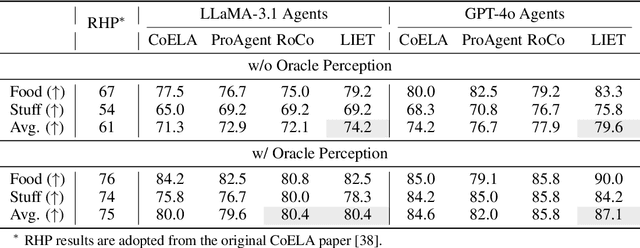
Large language models (LLMs) possess extensive knowledge bases and strong reasoning capabilities, making them promising tools for complex, multi-agent planning in embodied environments. However, despite LLMs' advanced abilities and the sophisticated modular design of agentic methods, existing LLM-based planning algorithms remain limited by weak adaptation capabilities to multi-agent embodied scenarios. We address this limitation by introducing a framework that enables LLM agents to learn and evolve both before and during test time, equipping them with environment-relevant knowledge for better planning and enhanced communication for improved cooperation. Inspired by centralized training with decentralized execution in multi-agent reinforcement learning, we propose a \textit{Learn as Individuals, Evolve as a Team (LIET)} paradigm for multi-agent LLMs adaptation. At the individual level, LLM agents learn a local utility function from exploratory datasets to better comprehend the embodied environment, which is then queried during test time to support informed decision-making. At the team level, LLM agents collaboratively and iteratively maintain and update a shared cooperation knowledge list based on new experiences, using it to guide more effective communication. By combining individual learning with team evolution, LIET enables comprehensive and flexible adaptation for LLM agents. Our experiments on Communicative Watch-And-Help and ThreeD-World Multi-Agent Transport benchmarks demonstrate that LIET, instantiated with both LLaMA and GPT-4o, outperforms existing baselines and exhibits strong cooperative planning abilities.
Revisiting Multi-Agent World Modeling from a Diffusion-Inspired Perspective
May 27, 2025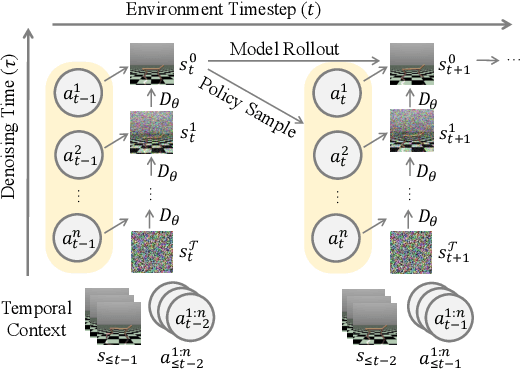
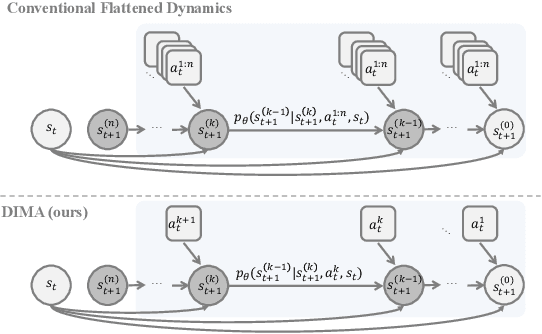
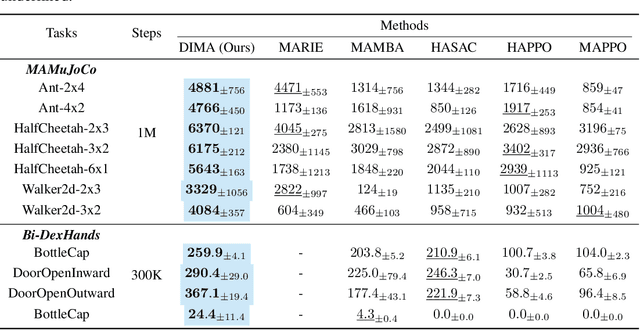
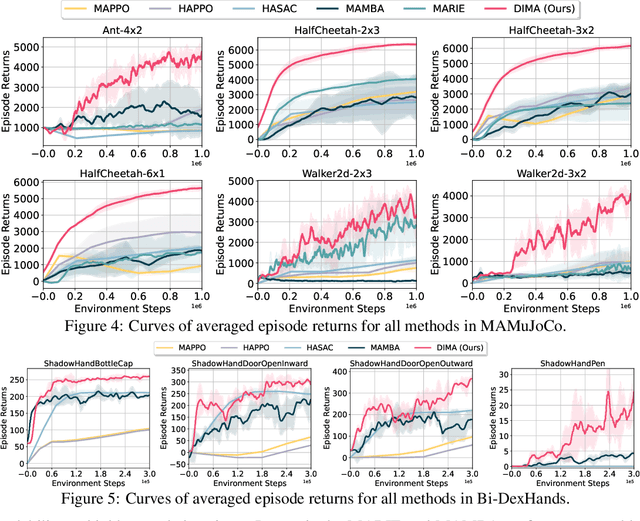
World models have recently attracted growing interest in Multi-Agent Reinforcement Learning (MARL) due to their ability to improve sample efficiency for policy learning. However, accurately modeling environments in MARL is challenging due to the exponentially large joint action space and highly uncertain dynamics inherent in multi-agent systems. To address this, we reduce modeling complexity by shifting from jointly modeling the entire state-action transition dynamics to focusing on the state space alone at each timestep through sequential agent modeling. Specifically, our approach enables the model to progressively resolve uncertainty while capturing the structured dependencies among agents, providing a more accurate representation of how agents influence the state. Interestingly, this sequential revelation of agents' actions in a multi-agent system aligns with the reverse process in diffusion models--a class of powerful generative models known for their expressiveness and training stability compared to autoregressive or latent variable models. Leveraging this insight, we develop a flexible and robust world model for MARL using diffusion models. Our method, Diffusion-Inspired Multi-Agent world model (DIMA), achieves state-of-the-art performance across multiple multi-agent control benchmarks, significantly outperforming prior world models in terms of final return and sample efficiency, including MAMuJoCo and Bi-DexHands. DIMA establishes a new paradigm for constructing multi-agent world models, advancing the frontier of MARL research.